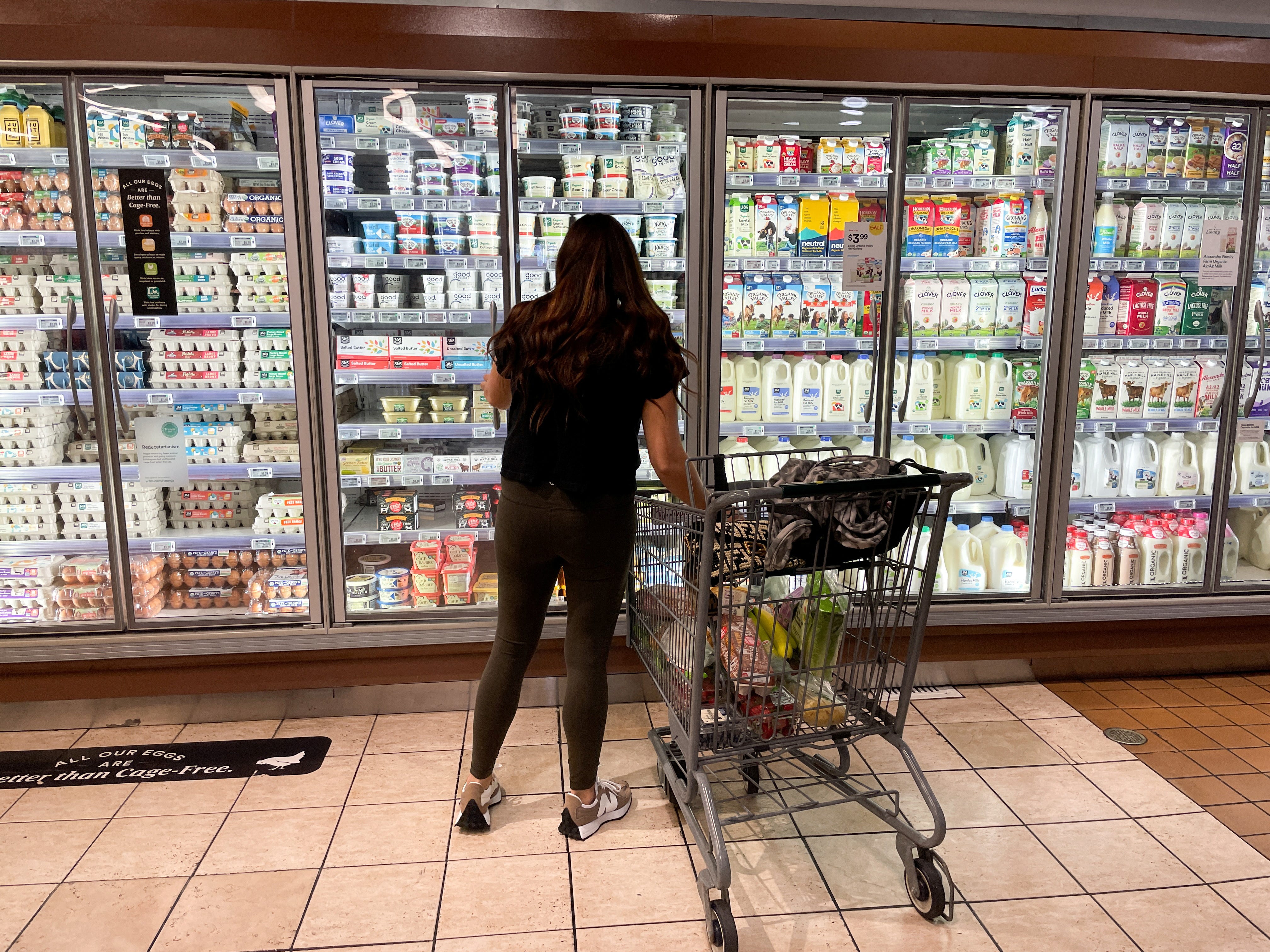
Families are going to drastic lengths to buy basic groceries

Alexandra Thompson and her husband both work full time, but the cost of groceries and other daily essentials like gas have risen so much that they've maxed out their credit cards and are buying only what
they can afford each week with cash.
"It feels like almost week to week that our groceries are becoming more expensive when we're not buying extra things," Thompson, 31, of Union City, Tennessee, said of the food they buy for themselves and their 9-year-old son. "We're getting just the essentials every week."
Americans surveyed in a new study by Omnisend, an e-commerce marketing platform company, are expressing similar struggles. More are borrowing money to pay for groceries. Consumers also said higher prices have changed how they feel about brands they once liked, and a majority of respondents also said they believe brands are using inflation as an excuse to raise prices more than necessary.
And nearly half of respondents blamed politicians for rising food costs.
More people are borrowing to pay for groceries
The rising food prices affect how consumers shop – as well as how they pay for groceries.
In a survey of 1,075 consumers in June, 30% of respondents said they used a credit card to pay for essentials, such as groceries, gas, utilities or medical bills, in the past three months, knowing they may not pay off their bill. USA TODAY was given an exclusive first look at the study by Omnisend.
An additional 20% said they borrowed from friends or family, 18% used buy now, pay later products, and 17% said they had to use savings meant for something else.
“The financial safety nets people once relied on for emergencies are increasingly becoming part of the monthly routine. When households are using credit and borrowing to cover essentials while also feeling they’re getting less for their money, it’s no surprise that confidence in both their finances and the companies raising prices starts to fade,” Marty Bauer, e-commerce expert at Omnisend, said in a news release.
Many families are feeling their wallets get squeezed, yet essentials like groceries need to be purchased, Bauer told USA TODAY in an email.
When you add in rising fuel costs and unexpected expenses like medical bills and car repairs, "families are forced to choose between carrying balances or going without," he said.
Another study reports consumers struggling to pay for groceries
Another recent study also highlighted that more shoppers are turning to credit cards or pulling from savings to pay for groceries, said Saloni Firasta Vastani, an associate professor of marketing at Emory University.
Nearly 1 in 5 adults paid for groceries with savings, and nearly 1 in 20 bought groceries with cash from a payday advance loan, according to the Urban Institute Well-Being and Basic Needs Survey for 2025, which came out in July. The institute is a Washington, D.C.-based nonpartisan think tank that conducts economic and social policy research.
When it came to credit cards, nearly 35% of adults ages 18 to 64 said they paid by credit card and paid that bill in full; 19.6% paid less than the full balance but always made the minimum payment; and 8.7% did not always make the minimum payment.
That means more than 1 in 4 working-age adults used credit cards to purchase food for their families and experienced repayment challenges, the institute said in a brief about its study.
Firasta Vastani, who studies behavioral pricing at Emory's Goizueta Business School, said it is particularly concerning that the 8.7% of respondents who didn't make a minimum payment rose from 7.1%, when the study was conducted in 2023.
"To me, that's a signal of potential issues," Firasta Vastani told USA TODAY. If consumers who qualify for a credit card are struggling, "there is likely a lower-income group that's struggling even more, and that is what I'm hearing more and more across the board."
But it seems all income levels are struggling.
Some of the heaviest rates of credit card usage among the Omnisend survey were reported by those in the highest income bracket. Nearly 35% of consumers making more than $150,000 a year reported using credit cards for their essentials, along with about 40% of those making $75,000 to $99,900 a year.
Struggling to make ends meet
Thompson and her husband make about $70,000 a year together and are just shy of qualifying for government assistance to make ends meet, she said.
The librarian said her family rarely breaks even each month, even though they've canceled all subscriptions and eat out maybe once or twice a month.
"There's no joy in living this way. I can't save anything to help me live differently," she told USA TODAY. Thompson said she is fortunate that her student loans are paid off and she owns her car, or her family would be in even more dire straits.
That only happened due to two deaths in the family, she said, allowing her to use inherited money to pay off her student debt and providing her with an inherited car.
Firasta Vastani said there is a cumulative effect of rising costs for food prices: not only individual prices going up but the whole grocery cart.
"It's reaching that price threshold where people are starting to notice it and feeling it," she said. "So, not only that one item that you're purchasing has gone up, but now it's trickled through the rest of your cart."
Firasta Vastani said she's noticed it in her own grocery cart.
"I'm like, 'What?' I can't believe my bill was as high as it was. I'm like, 'I bought like five things,' " she said.
Back-to-school savings: You can shop tax-free for school supplies in these 18 states. See where
Shrinkflation, consumer trust and blaming politicians
The study also included highlights from consumers on other insights, including:
Shrinkflation: 89% of respondents said they regularly notice when companies shrink packages while prices stay the same. Twenty-nine percent of respondents consider this type of price increase to be the most unfair, and 59% said they noticed it regularly. Manufacturers have been shrinking packaging for some time, and the practice accelerated during the pandemic, said Firasta Vastani. She said she wouldn't be surprised if manufacturers are continuing the practice now as consumers are very price sensitive. Trust in brands is at a low point: 85% said they believe brands often use inflation to justify larger-than-necessary price increases. Among respondents, 67% said higher prices have changed how they feel about brands they once liked, with more than half, or 56%, who said they have stopped buying the brands. People are blaming politicians and policies: 45% said the government is more responsible than businesses for rising prices. Thompson said she agrees with respondents and blames politicians, saying she believes tariffs are a major factor for rising costs. Bauer places the blame on both politicians and manufacturers. "There’s plenty of blame to go around," he said.
Regardless of the reasons, Thompson said life is hard and "the economy seems to be getting worse."
Betty Lin-Fisher is a consumer reporter for USA TODAY. Reach her at blinfisher@USATODAY.com or follow her on X, Facebook or Instagram @blinfisher and @blinfisher.bsky.social on Bluesky. Sign up for our free The Daily Money newsletter, which breaks down complex consumer and financial news. Subscribe here.