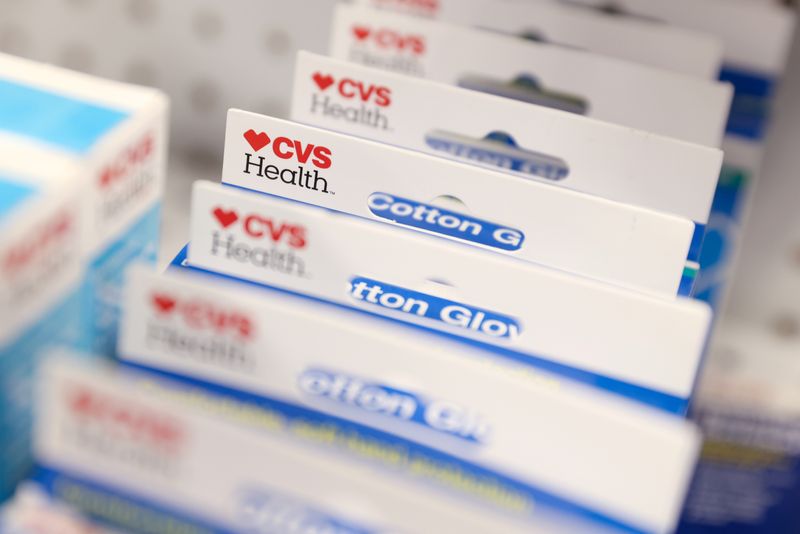
CVS will split up its pharmacy and insurance business into two companies, WSJ says

By Sabrina Valle and Siddhi Mahatole
Nov 3 (Reuters) - CVS Health plans to break up its $117 billion business, separating its retail pharmacies from the Caremark pharmacy benefit management operations and
the Aetna insurance company it bought nearly a decade ago, the Wall Street Journal quoted the company as saying on Tuesday.
CVS Health, which is set to report quarterly results on Wednesday, did not respond to a Reuters request for comment.
"We believe based off of where we are and how we're performing, the businesses are best served by splitting," CVS Chief Executive David Joyner said, according to the Journal. "We're basically taking what I believe is one great company and making it two." Both would be publicly traded, the Journal said.
Health companies have been consolidating for years, with each new purchase ratcheting up pressure from critics who say there are conflicts of interest between the businesses and that they contribute to rising US spending on healthcare, the highest in the world.
The move unwinds the premise of the CVS-Aetna deal, in which the companies argued that with economies of scale they could help America save on costs.
CVS, with about 9,000 retail pharmacies in the United States, bought Caremark nearly 20 years ago and after its $78 billion purchase of Aetna, made a series of smaller acquisitions including businesses that offer clinical health services.
Shares of the company were up 0.1% in extended trading.
REGULATORY ACTION
The deal comes as lawmakers and regulators have pressured CVS and companies like it to make major changes to how they operate, though CEO Joyner told the Journal that regulatory issues were not driving the decision.
The Trump administration plans new rules that will require CVS and rivals to provide more information to the public and customers about how they price services and profit from interdependent health businesses. Some states want limits on what businesses can be in one health company.
The Federal Trade Commission, aiming to improve competition, settled a case with CVS this summer that restricts how its pharmacy benefit manager Caremark does business with other pharmacies. Pharmacy benefit managers, or PBMs, oversee prescriptions and other pharmacy services for the government, corporations and other big employers.
One of the companies will keep the CVS Health name, be run by Joyner, and hold the insurance and PBM units as well as Oak Street Health's primary care clinics, the home health visit company Signify Health, and CVS's specialty-drug business, the Journal said.
The second company will be called CVS Pharmacy and include mail-order pharmacy, retail drugstores and the MinuteClinic chain, the newspaper reported.
PRESSURE ON INTEGRATED HEALTH BUSINESSES
CVS explored options including a potential breakup in 2024, Reuters reported at the time, as the company grappled with challenges across its businesses and financial underperformance at Aetna. Its CEO Karen Lynch was fired and replaced with Joyner.
Investors may treat the distinct companies as more valuable than the integrated one, said Mizuho analyst Ann Hynes. CVS shares trade at 10.8 times the analyst's 2027 adjusted earnings target, below the 10-year sector average of 15.7 times.
"We believe separating the insurance business could unlock meaningful multiple expansion potential for shareholders, who would be expected to retain ownership stakes in both newly formed companies," she said.
Pharmacy benefit managers are facing growing political and regulatory scrutiny on concerns that healthcare consolidation has given these companies, which act as middlemen in the drug supply chain, too much influence over prescription drug prices.
"A potential split could also help relieve some regulatory concerns (particularly at the state level) regarding joint ownership of a PBM and retail drug store," said Evercore ISI analyst Elizabeth Anderson.
At the same time, health insurers have struggled with rising medical costs as consumers increased their use of healthcare services after the end of the COVID-19 pandemic. Aetna exited Affordable Care Act plans and cut back on benefits and offerings in Medicare Advantage plans for people aged 65 and older or with disabilities.
Joyner told the Journal that putting together Aetna with Caremark took advantage of synergies in two units that manage health and drug benefits, and that its two healthcare assets Signify and Oak Street aimed at people aged 65 and older will strengthen Aetna's Medicare business. The two independent businesses will retain some commercial agreements, he said.
CVS pharmacies are facing similar pressures to peer Walgreens, which was acquired by private equity firm Sycamore Partners last year in a complex deal using creative financing.
US pharmacy chains are losing shoppers to Amazon for its convenience as the in-store experience has deteriorated, with products increasingly locked behind glass. More customers are also having prescriptions delivered, skipping store visits that once drove add-on purchases.
The buyer universe for a standalone retail pharmacy business is limited, as evidenced by Walgreens' drawn-out sale process.
Shares of CVS have rebounded under Joyner, who has driven improvements in financial results since he took over in October 2024, helping lift the company's market value to about $117 billion.
The Financial Times earlier in the day reported plans for the breakup.
(Reporting by Siddhi Mahatole in Bengaluru; Additional reporting by Abigail Summerville; Writing by Peter Henderson and Caroline Humer; Editing by Rashmi Aich and Sonali Paul)