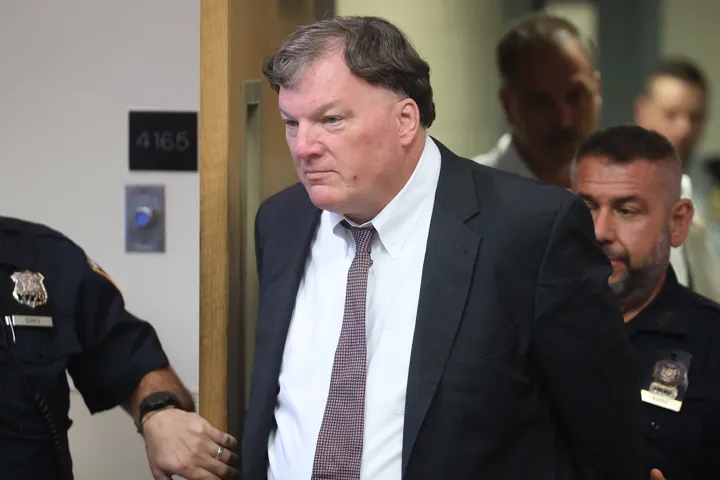
Long Island Serial Killer Rex Heuermann Pleads Guilty to 7 Murders


Click here to read the full article.
Eight grieving families got answers Wednesday when Rex Heuermann, who has been accused of being the Long Island Serial Killer, admitted to murdering eight young women at the Arthur M. Cromarty Court Complex in Suffolk County, New York.
The 62-year-old Massapequa, Long Island, resident pleaded guilty to killing Melissa Barthelemy, 24, Megan Waterman, 22, Amber Costello, 27, Maureen Brainard-Barnes, 25, Jessica Taylor, 20, Valerie Mack, 24, and Sandra Costilla, 28 over the course of nearly 20 years. Heuermann also admitted guilt in the murder he was not previously charged with, Karen Vergata, 34, who had disappeared in 1996. Her remains had gone unidentified until in 2023, when she was ID’d via genetic genealogy. Heuermann had initially pleaded not guilty to the seven murders and was set to go to trial in September.
Heuermann agreed to several life sentences with no possibility of parole and has given up his right to appeal in exchange for no further prosecution for the eight victims. He also agreed to be interviewed by the FBI’s Behavioral Analysis Unit. He will be sentenced on June 17.
Heuermann, a former architect, was arrested outside his office in Manhattan in July 2023 and was initially charged with the murders of Barthelemy, Waterman, and Costello. Over the following two years, as police built their case against him, he was also charged with the murders of Brainard-Barnes, Taylor, Mack, and Costilla. He was held without bail, with a 32-page court document detailing the profusion of evidence that led to his arrest.
Bail was denied due to the “heinous nature” of the crimes, wrote the prosecution, noting how long it took to arrest Heuermann. The document also highlighted “his recent [internet] searches for sadistic materials, child pornography, images of the victims and their relatives” and his access to firearms.
Prosecutors also found DNA evidence linking Heuermann to crime scenes, as well as documents laying out plans for past murders and any possible issues that might arise and lead to his capture, including “blood stains” and “DNA,” according to the BBC. Heuermann also had documents that detailed killing methods and lessons he learned from prior murders, and prosecutors seized hundreds of electronic devices from Heuermann’s home, as well as 300 guns.
The Long Island Serial Killer has mystified that state for decades, from 1993 until 2011, when the bodies of young women started appearing on Gilgo Beach, along Long Island’s southern coast. In May 2010, Shannan Gilbert, a sex worker, went missing in the area, and police began searching the beach. While they didn’t initially find her body, in December of 2010 they did find Brainard-Barnes, Barthelemy, Waterman, and Costello, who were dubbed “The Gilgo Four.” Each was found wrapped in camouflage-style burlap in the same area. According to investigators, the women were found near each other, not far from the parkway. All were petite women in the their twenties who had advertised sex work on Craigslist. (While Gilbert’s remains were found in 2011, it’s been in contention whether or not she was murdered. The Suffolk County Police Department believes she died accidentally.)
Over the next decade, the investigation stalled as the investigating agencies became mired in scandal. In 2022, Suffolk County District Attorney Ray Tierney launched a new task force to dig into the case, and was able to connect Heuermann to a pickup truck a witness saw one of his victims getting into in 2010. Detectives also linked his DNA to hair found on one of the women’s bodies after retrieving his discarded pizza crust from the trash in Midtown Manhattan, where he worked.
Cell phone data then helped investigators hone in further on the Long Island resident, who used Barthelemy’s phone to harass her family following her murder. Heuermann also mocked victims’ families by calling them on a burner phone. He purchased the device with his personal credit card, though, leading police to his door. He used his personal phone to check one of the burner emails he used to contact sex workers and Googled his crimes using one of those accounts. “[That] email account was also used to search for a number of podcasts and/or documentaries regarding this investigation, as well as repeatedly viewing hundreds of images depicting the murdered victims and members of their immediate families,” prosecutors wrote. “Significantly, Defendant Heuermann also searched for and viewed articles concerning the very Task Force that was investigating him.”
“I’m grateful for the hard work that’s been done, grateful today is happening, hopeful for the future,” Jasmine Robinson, Taylor’s cousin, previously told CBS News. “I hope that she’s remembered as a beautiful young woman, not what her occupation was at that time. She’s loved and missed every day.”
Allie Pertel, Waterman’s sister, told the outlet she felt “anger and relief. It’s starting all over again. She was a vulnerable, naive, drug addict girl who was very easily influenced by this monster of a man.”
Costello’s aunt, Bonnie Sasse, called her niece “a sweet, loving, giving young woman. She just went down the wrong road,” adding, “All of the family members of these poor victims, we never thought we’d see this day. I’m rejoicing. I know they are, too.”
This is a developing story…