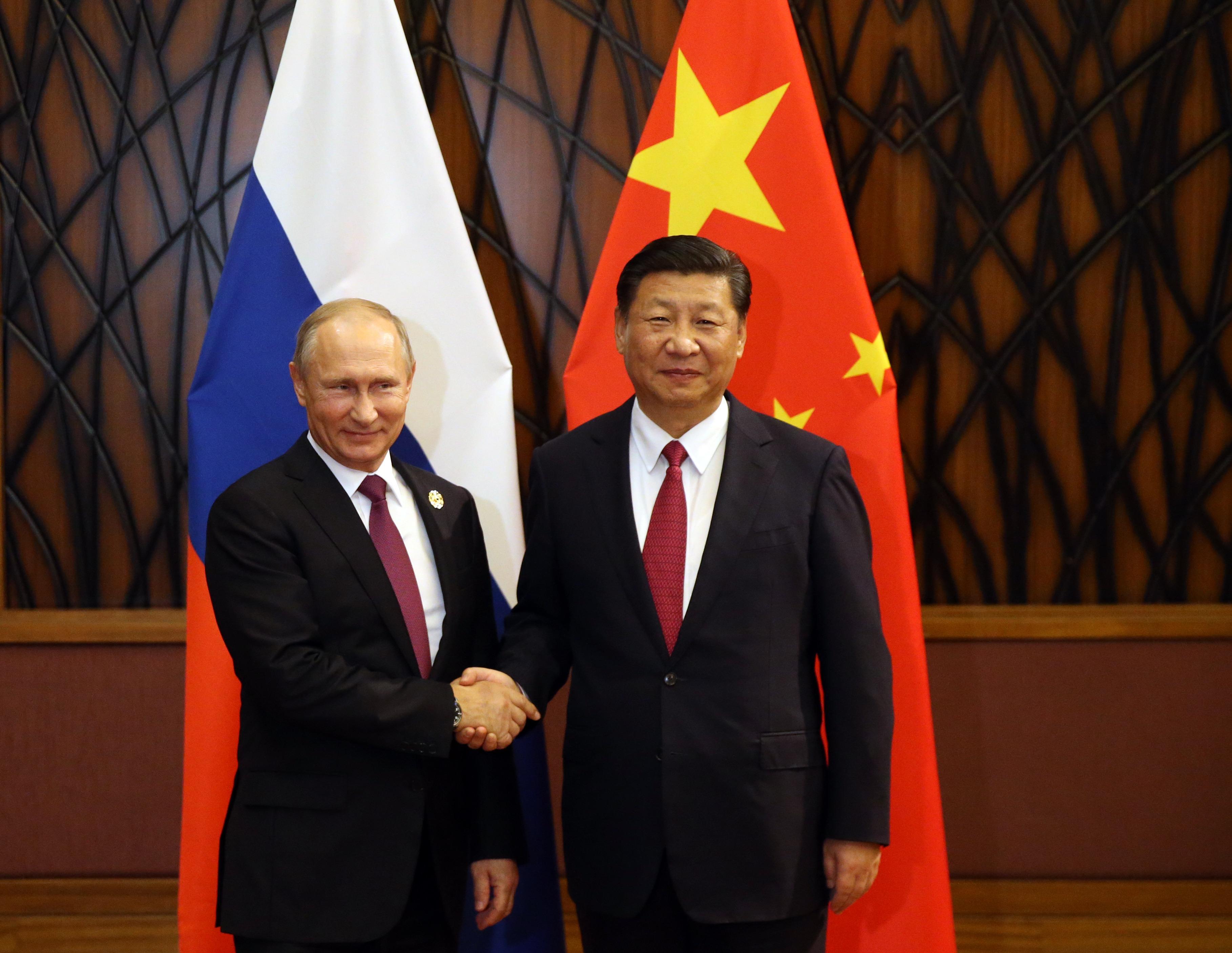
Brookings Institution Warns of Increased Aggression from Russia and China if President Trump Appears Weakened

What's Happening?
Robert Kagan, a senior fellow at the Brookings Institution, has warned that Russia and China could become more aggressive over the next two years if they perceive President Trump as politically weakened,
especially after Democrats gained control of both chambers of Congress. According to CNBC, Kagan's comments highlight concerns that a perceived decline in President Trump's influence might embolden these nations. He noted that the war with Iran has exposed U.S. military capacity limitations, particularly regarding interceptors and missiles, which are crucial in the Asian theater. The deployment of three U.S. aircraft carriers to the Middle East has also reduced the naval presence in Asia, potentially creating an opportunity for China to act more assertively in the region.
Why It's Important?
This assessment from the Brookings Institution carries significant weight for U.S. national security and foreign policy. A perceived weakening of President Trump's political standing could lead to a more challenging international environment for the United States. If Russia and China believe the U.S. is less capable or less resolute, they might test American resolve, potentially leading to increased geopolitical instability. This could manifest in various ways, such as heightened military posturing, more aggressive territorial claims, or attempts to undermine U.S. alliances. For the U.S., this necessitates a careful balance of projecting strength and maintaining diplomatic channels, especially as discussions for a trilateral summit between President Trump, Chinese President Xi, and Russian President Putin are underway. The implications extend to defense spending, strategic alliances, and the overall global balance of power, directly affecting U.S. economic and security interests.
What's Next?
The U.S. administration will likely face increased pressure to demonstrate strength and stability on the international stage to counter any perceptions of weakness. This could involve strategic military exercises, diplomatic initiatives to reinforce alliances, and clear communication of U.S. foreign policy objectives. The upcoming APEC Leaders' meeting in Shenzhen, where a potential trilateral summit is being discussed, will be a critical event. The outcomes of such high-level diplomatic engagements will be closely watched for signs of U.S. resolve and its ability to manage complex relationships with major global powers. Furthermore, the U.S. Congress, now under Democratic control, may seek to influence foreign policy decisions, potentially leading to shifts in approach towards Russia and China, and impacting the administration's ability to project a unified front.
Beyond the Headlines
The Brookings Institution's warning highlights a deeper concern about the interplay between domestic politics and international relations. The perception of a U.S. president's political strength, or lack thereof, can have tangible effects on global stability. This underscores the idea that internal political dynamics are not isolated but are closely watched and leveraged by other state actors. The concept of 'strategic vacuity' mentioned in relation to President Trump's foreign policy suggests that a lack of clear, consistent strategy can create vulnerabilities that adversaries may exploit. This situation calls for a re-evaluation of how U.S. leadership is perceived globally and the importance of a coherent, bipartisan foreign policy to maintain stability and deter potential aggression, regardless of domestic political shifts.