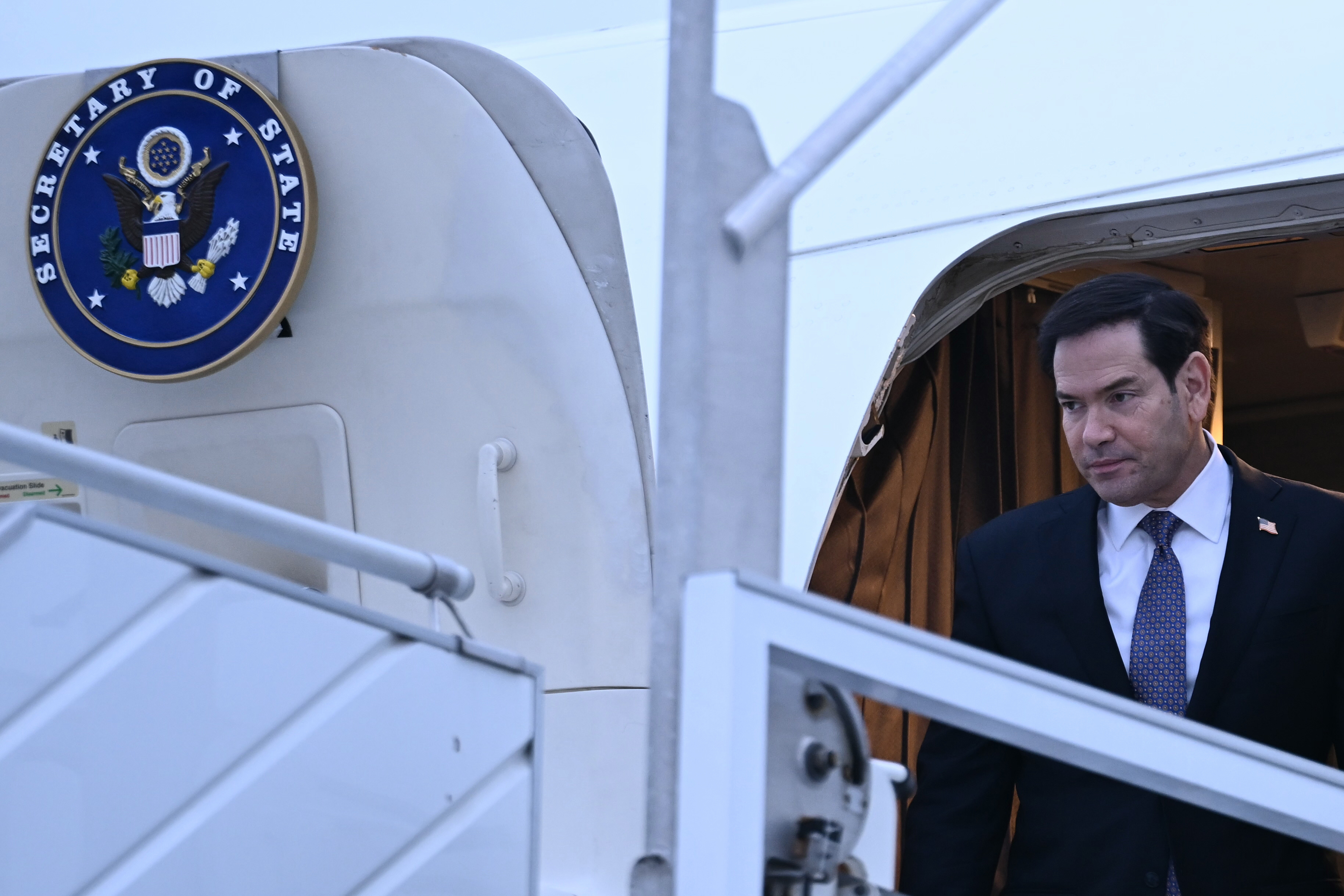
G7 talks in Paris try to tackle global crises with uncertainty high over the US approach

PARIS (AP) — Top diplomats from the Group of Seven industrialized democracies gathered in Paris on Monday with clear differences on global crises and questions about how U.S. President Donald Trump will
approach foreign policy after his Republican Party’s heavy losses in the midterm elections.
Whether on the Russia-Ukraine war, Iran or the International Criminal Court, the sides appeared far apart as two days of talks got underway, although all agreed on the need to end the conflicts as quickly as possible.
U.S. Secretary of State Marco Rubio faced questions about whether the Trump administration will shift its positions on those issues and others like energy security and artificial intelligence that dominated discussions among foreign ministers from the U.S., U.K., Canada, France, Germany, Italy and Japan.
The Paris meeting is Rubio’s first overseas trip since last week's midterm elections that dealt Republicans severe losses and cost them control of Congress, partly because of deeply unpopular policies such as the Iran war. The talks also come as major protests unfold across Europe, including in the French capital.
US politics are likely to surface at allies’ meeting
Asked about allies wanting to know what comes next after the elections, Rubio told reporters Sunday before leaving that the countries he is meeting with this week understand American politics and “they, too, have experienced divisions in government and divisions in their own system.”
Canadian Foreign Minister Anita Anand, whose country has faced withering criticism and insults from Trump, said how Washington will proceed is an open question.
“In terms of the U.S. and its approach, I will say that the president has executive powers,” she told reporters in Paris. “The House and the Senate have changed leadership, so it’s very much a question of what the approach will be.”
European Union foreign policy chief Kaja Kallas said Europe also was waiting to see how the midterms would affect U.S. policy.
”The midterm elections showed the will of American people and the elections always bring results also in terms of policy changes,” she told reporters. “We are willing to work with whatever Congress or Senate or administration there is to really focus on the issues that we do together and focus on the issues where we can have maximum impact together.”
Yet there has been little sign that the Democrats’ gains will affect Trump's strategy, and his first major personnel decision has been to install Stephen Miller, a hard-line supporter who has advocated extreme positions on both domestic and foreign policy, as chief of staff.
Rubio is seen by many as presenting a gentler side to Trump’s often brusque approach to both friends and foes, but there has been speculation — which he has denied — that he might choose to leave the administration early to prepare for a 2028 presidential run.
Wars in Iran and Ukraine will be major topics
Trump has floated the idea of a partnership with Europe to bring Russia's war in Ukraine to an end. His envoys, Steve Witkoff and son-in-law Jared Kushner, are set to meet Ukrainian and Russian officials in the United Arab Emirates starting Tuesday to discuss potential compromises.
Rubio said postwar security guarantees for Ukraine and the rest of Europe have been a top concern for allies.
“There’s been some advances made in what that architecture could look like post-conflict,” Rubio said Sunday. “Nothing’s been finalized yet, and maybe some progress can be made in Abu Dhabi.”
German Foreign Minister Johann Wadephul, who met separately with Rubio on Monday, said he welcomed the Abu Dhabi talks but stressed that Europe must be part of any resolution.
"I am still very grateful to the United States of America for making every effort to get the parties to the conflict to the table,” Wadephul said. “But I made clear again here that Europe belongs at this table. There can be no solution without Europe, only with Europe.”
Rubio said he expects a lot of questions from allies about the Iran war. Qatari and other mediators have proposed an interim solution to end the deadlock over a conflict that has sent fuel prices soaring because of instability in key shipping lanes in the Strait of Hormuz and Red Sea.
Rubio said the sides are not on “the verge of a breakthrough,” while reiterating that Trump prefers a diplomatic solution. But he noted of diplomacy that “right now, it hasn’t been very productive because the Iranian demands are simply not just unacceptable but, in some cases, outrageous and ridiculous and really not realistic.”
There's uncertainty about a consensus, even among allies
France — whose other priorities include Africa, China, Cuba and Haiti — has invited Brazil, Egypt, Saudi Arabia and Ukraine to participate in some discussions.
After the first meetings Monday, Rubio posted on X that he had “emphasized the need for UN agencies to eliminate wasteful bureaucracy and make humanitarian aid more efficient. Our assistance must remain temporary, targeted, and accountable.”
The comment signaled the administration would maintain its demands for reform at the United Nations. It has already withdrawn from several U.N. and other multilateral bodies and unsettled G7 partners over its opposition to the International Criminal Court.
The administration is pushing to dismantle the international war crimes court to which all G7 members except the U.S. belong. It has imposed severe sanctions on the court and several of its employees, saying the ICC is trying to investigate Americans.
In a meeting with French Foreign Minister Jean-Noël Barrot, Rubio said he had raised “U.S. fundamental concerns about the International Criminal Court."
The Trump administration is worried about the EU invoking a statute that would immunize European governments, companies and individuals from secondary U.S. sanctions targeting those who support the ICC. U.S. officials have said the administration would respond if the “blocking statute” is implemented.
Kallas, the top EU diplomat, defended the ICC and said the bloc was trying to “show our American partners that their worries about the ICC regarding countries are actually not based on the Rome Statute or the regulations." The Rome Statute is the treaty that created the court.
“In this moment where we see more war crimes across the world committed, we need more accountability, not less,” she said.