Russia, Ukraine agree prisoner swap as US says lack of trust holds back talks

By Roula Rouhana
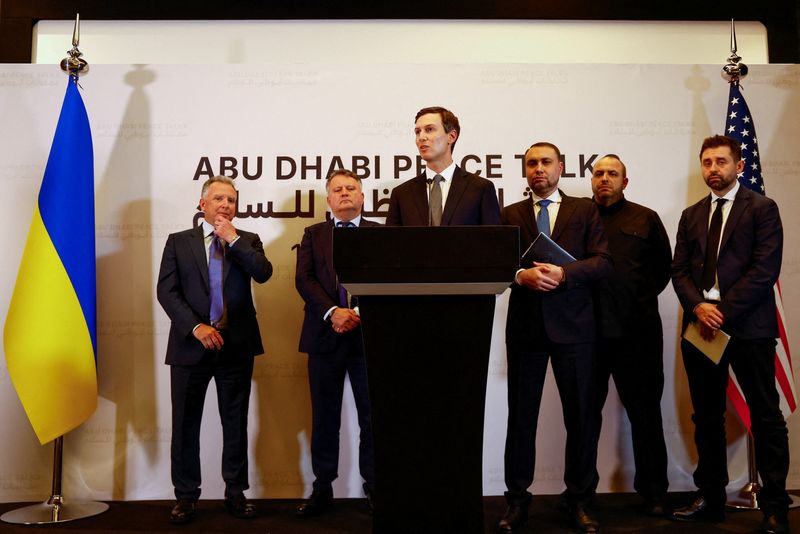
ABU DHABI, Nov 11 (Reuters) - Russian and Ukrainian negotiators agreed to a major prisoner exchange at two days of peace talks in Abu Dhabi that ended on Wednesday, but US mediators said
differences remained on major issues, including territory.
At their first negotiations in nine months, the two countries agreed in principle to exchange prisoners of war and to determine the numbers on Thursday.
US envoy Jared Kushner said the new swap would be the "biggest humanitarian release of prisoners" in the 4-1/2-year-old war, while Ukrainian President Volodymyr Zelenskiy said its scope would be "significant."
Both Russia and Ukraine said that progress had been made in the Abu Dhabi talks and negotiations would continue. But there was little else in the way of concrete breakthroughs announced after the US-brokered meetings.
Kushner, US President Donald Trump's son-in-law, said mediators were appealing to each side's interests to end Europe's biggest conflict since World War Two and he expressed confidence they would find a pathway to peace.
Despite public optimism from Trump, there has been no sign of major compromises on the main issues after more than 4-1/2 years of war since Russia's full-scale invasion of Ukraine.
Kyiv has strongly rejected Russian President Vladimir Putin's demands to surrender the whole of the eastern region of Donbas in return for peace. With talks deadlocked on land, US mediators have tried to steer discussions towards postwar security guarantees and reconstruction.
"The reality is there is no trust right now between the sides and that is to be expected after a conflict like this," Kushner said, adding that the talks had touched on territorial issues and that these would be the hardest to resolve.
"I think this was a good first step," he said.
Kushner said he and fellow US envoy Steve Witkoff will travel to Moscow on Thursday for talks with Putin, where they will raise the question of adding European partners to the talks, who Kushner said must be at the table.
The US negotiators then plan to fly to Ireland to meet with Zelenskiy, who is due to attend a meeting of European leaders there.
Zelenskiy told reporters in Dublin on Wednesday that Ukraine was focused on achieving progress on an accord this year.
"A lot will depend today on the format of the dialogue of the American and Russian sides tomorrow... I believe it is also very important for the Americans...to achieve a result this year, in my view, given what we are seeing happening," he said.
"And it seems to me that they really do want this very much."
ATTACKS CONTINUE
Russia and Ukraine accused each other of launching attacks overnight, despite the Abu Dhabi peace talks.
Russia hit six electricity substations in central Ukraine, Ukrainian officials said, and an attack on a market in the Odesa region killed three people. A Ukrainian drone attack killed one person in Russia's Belgorod region, local officials said.
Ukrainian negotiator David Arakhamia said the talks had been tough, with Russia's delegation arriving with "strict directives", but the conversations provided "good momentum" towards reaching a solution by the end of the year.
Although European officials and NATO representatives met US and Ukrainian envoys in Abu Dhabi, Russia's delegation refused to meet them. Arakhamia said future peace talks must be multilateral and include Europe at the table.
Russia's chief negotiator, Vladimir Medinsky, told Russian state TV he thought a peace deal was closer after the talks but "a great deal depends on Ukraine, on the US stance, and on whether Europe comes to its senses".
Russia has repeatedly criticised European military support for Ukraine. As the Trump administration has scaled back its direct aid to Ukraine, Europe has become the leading provider of finance and military support to Kyiv.
Reaffirming Moscow's long-standing demands, Medinsky told Russian state news agency TASS that "every inch" of Russian land would be returned to Russia — an apparent reference to Putin's insistence that Ukraine surrender all of the Donbas.
Ukraine had hoped the Abu Dhabi talks would make progress towards a ceasefire on Black Sea grain shipments as a means of de-escalation, but Foreign Minister Andrii Sybiha, on a visit to Turkey, said Kyiv was still awaiting a Russian response.
FRONT LINE STATIC
Russian forces control about a fifth of Ukraine, much of it captured before the 2022 invasion, and their progress on the battlefield has slowed this year.
With the front line largely static, Moscow has been pounding Ukrainian cities and energy sites, while Ukraine has stepped up attacks on Russian oil refineries and other infrastructure.
Russian officials are calling for a broad agreement on European security architecture to be reached before tackling the specifics of the war.
Before its full-scale invasion in February 2022, Russia demanded the withdrawal of NATO forces from countries that joined the alliance after 1997, which the alliance rejected.
European officials say wider security talks should only come after a ceasefire, and that Russia should not be allowed to influence Europe's security arrangements or be rewarded for starting the war.
Trump said last week the war was close to being settled in a "big beautiful agreement" that could include security guarantees for Europe. He has frequently predicted breakthroughs that have not materialised.
(Reporting by Reuters reporters in Abu Dhabi, Moscow, Kyiv and Dublin; Writing by Olena Harmash and Daniel Flynn; Editing by Timothy Heritage, Gareth Jones, Ron Popeski and Cynthia Osterman)